
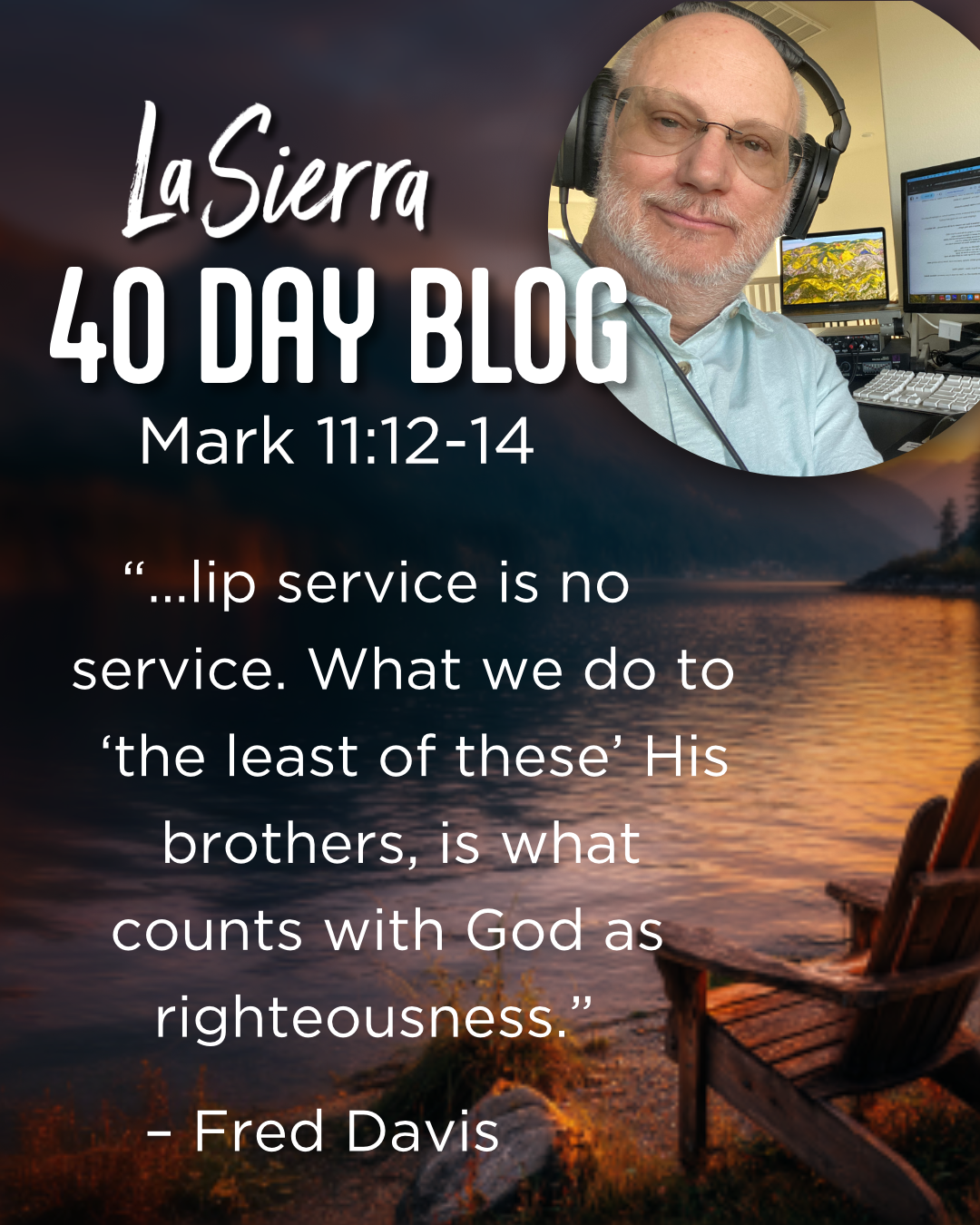
“On the following day, when they came from Bethany, he was hungry. Seeing in the distance a fig tree in leaf, he went to see whether perhaps he would find anything on it. When he came to it, he found nothing but leaves, for it was not the season for figs. He said to it, ‘May no one ever eat fruit from you again.’ And his disciples heard it.” Mark 11:12-14 NRSVUE
On a first pass reading, it might seem to the reader that Jesus was having a less than perfect day. He was hungry, after all. No wonder the leafy fig tree seemed attractive, and no wonder the disappointment when no fruit could be found. Is it just a random demonstration of His human nature?
But wait… there is an odd detail included in the story. It was not the season for figs. That being the case we are left to wonder if perhaps Jesus was not aware of this, or was He unfairly angry with the tree?
Yet, we have pretty good evidence that nothing recorded about Jesus’ activity on earth is “random” or casual. The gospel writers pursued their story-telling with dedicated purpose. Mark is often noted as portraying Jesus as a “man of action.” I think Mark realized that Jesus was, and sought to portray Him, as a “man on a mission.” Every story Mark records moves us along a specific line, as Jesus approaches the cross. This story about the unproductive fig tree is not a parenthetical insertion, but a parabolic object lesson for the disciples and for the ages.
If Jesus knew it was not the season for figs, why then was He surprised by the lack of figs? Did he really expect to find figs?
Or did He, knowing full well that there would be no fruit, approach the precociously leafing tree precisely to teach the lesson commonly associated with these verses? Specifically a warning against “having a form of Godliness, but denying the power thereof” (2 Timothy 3:5 KJV). Given that the fig tree is used in Scripture to represent the nation of Israel, the lesson should have been clear to the disciples. Couple that general knowledge with Jesus’ frequent commentary on the hypocrisy of the Pharisees (and the Sadducees), and the meaning is addressed specifically to the ruling religious classes of the day.
By the time Paul was writing to Timothy (see the verse above), even though the story itself is not directly referenced, the lesson was undoubtedly clear. Interestingly, it seems that Paul found it appropriate to apply the lesson to individuals as well as to the national religious structure of Judah.
The fact that the fig tree actually withers and dies within a day is suggested to foretell the overthrow of the temple as a symbol of the Jewish nation. But I note that the significance of the whole Temple-based system of worship (and political control) was overthrown with the crucifixion of Jesus.
On a personal level, the withering of the tree stands in parallel to Jesus’ parable of the true vine and the branches grafted in (John 15:6-8). The unfruitful branches are cut off and burned in the fire. The point seems clear enough: lip service is no service. What we do “to the least of these” His brothers, is what counts with God as righteousness (Matt. 25:40).
As perhaps an aside on why the fig tree may have had lots of leaves but no fruit, I learned something interesting on the University of California Integrated Pest Management Program website. Here’s the point that interested me: Trees heavily fertilized with nitrogen produce an excessive amount of leaves which suppresses fruit production. That may be further compounded by improper irrigation. Either too much or too little water may cause a fig tree not to fruit.
Fertilizer is to trees as leavening is to bread dough. Jesus warned the disciples to beware the leavening of the Pharisees and the Sadducees (see Mark 8:15). It occurs to me that the hypocrisy of a legalistic, doctrinaire self-righteousness may well be the cause of a life filled with religious form but devoid of the fruit of the Spirit (see Galatians 5:22-23).
A theme oft repeated in the Old Testament, from the Torah through the Prophets is summarized nicely in Micah 6:8, “God has shown us what is good! And what does God REQUIRE of us? Act justly (do the right thing), love mercy (be kind) and walk HUMBLY (not proudly) with your God!” (Fred’s paraphrase)
This is the whole story. This is how we work out our salvation in gratitude to God. Love one another as Jesus Christ has loved us!
Fred Davis is a retired educator who enjoys his time with family, singing with the William Chunestudy Men’s Chorus, and participating in the Liturgical Service at the La Sierra University Church.