
Christmas is sacred across much of Latin America and its diaspora. We call it Noche Buena (the Good Night), and for many families, it holds more meaning than Christmas Day itself. It is a night set aside for worship, food, being with family, and having fun. Becoming a parent to a two-year-old has made me think more deeply about the traditions I want my son to experience, because traditions shape who we are.
Growing up as part of the Puerto Rican diaspora in New York City, I learned to make the holiday food called “pasteles.” This meal was rooted in love, identity, and quiet resistance. I remember how badly I wanted to help make pasteles. As a child I always wanted to grate the green plantains. I wasn’t allowed to help in that part of the process because my mom was afraid that I would cut myself. When I was finally promoted to that position I didn’t realize how much work went into it. It felt like I was working out!
Pasteles aren’t a quick holiday food to prepare. Pasteles require over twenty ingredients, four to six root vegetables that must be peeled and grated, hours of preparation, and nearly a full day of cooking and assembling. For it to be ready for dinner, the whole family would have to get involved.
Making pasteles turned our kitchen and living room into a communal workspace. Someone peels, someone grates, someone seasons the meat, someone washes banana leaves, someone ties the bundles. Stories are told. Arguments happen. Laughter breaks out. Time slows down in a society that keeps people chasing things and working themselves tired.
Pasteles are a pre-colonial dish shaped by Indigenous, African, and Spanish influences. Even though the name “pasteles” is Spanish, the techniques are not entirely European. Wrapping food in leaves and boiling it reflects the Taíno cooking methods. The grated root-vegetable masa and seasoning bases reflect African culinary practices carried by enslaved people. Some food historians argue that the Spanish name for this dish became a linguistic cover that allowed Afro-Indigenous practices to survive under colonial rule.
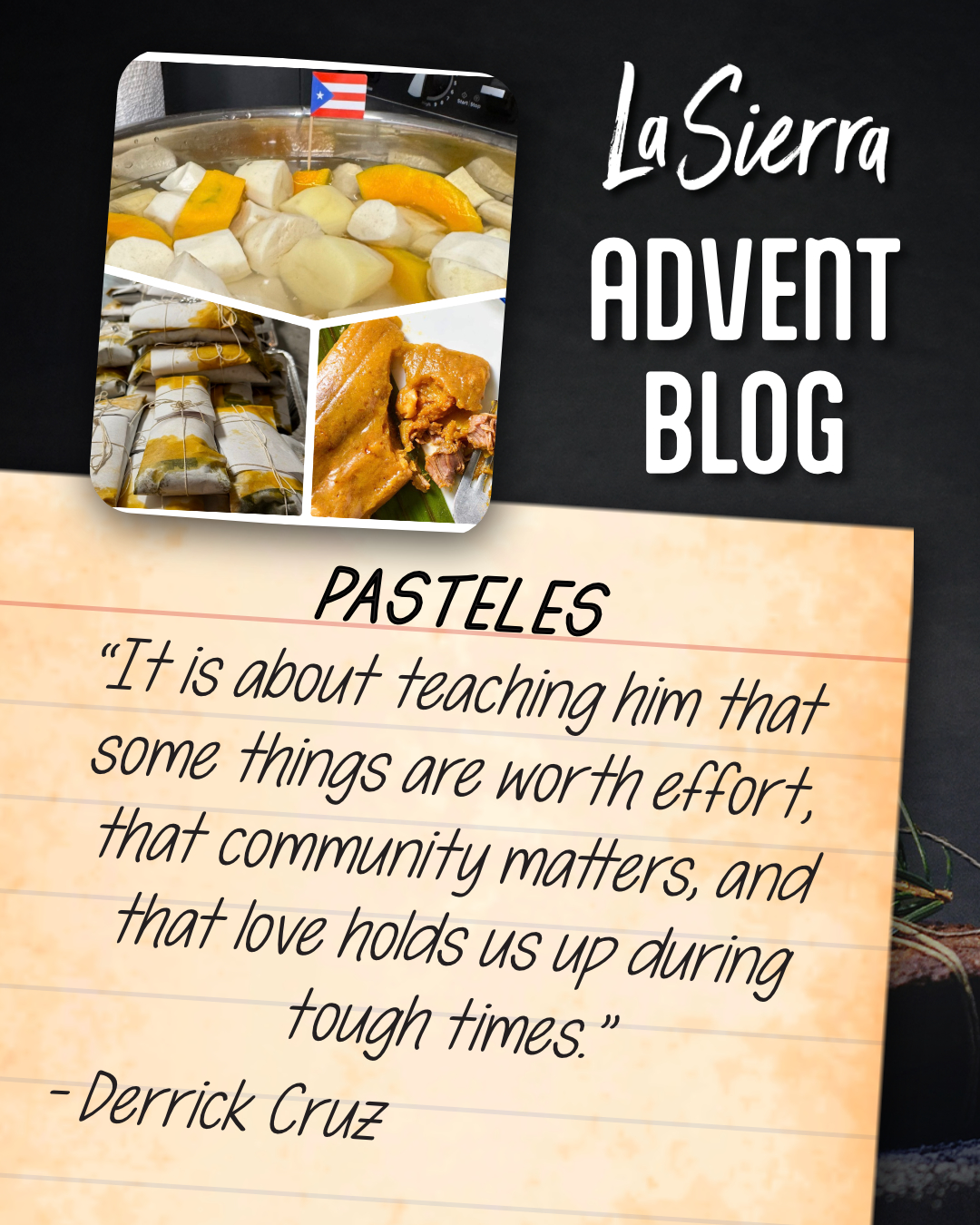
For Puerto Rican families, especially those who migrated to places like New York City, making pasteles became a way of remembering who we are in places that tried to reshape us. Food carried memory when language, land, and political power were taken away. Passing this tradition down to my son is about more than nostalgia. It is about teaching him that some things are worth effort, that community matters, and that love holds us up during tough times.
When I think about Noche Buena, I also think about the night before Jesus’ birth. I think about those who were living under occupation and uncertainty, waiting for a Messiah who promised peace and restoration. Waiting for Christ’s arrival today feels similar. May your traditions bring joy, community, love, and the courage to resist a world of consumption and fear of the other.
Pasteles
Ingredients:
Masa/Dough (There are different variations):
- Green bananas
- Green plantains
- Yautía (malanga)
- Sometimes yuca or ñame
- Calabaza (squash)
- Achiote oil
- Salt
Filling:
- Meat
- Sofrito (Essential base if Puerto Rican Cuisine)
- Garlic
- Onion
- Sazón
- Adobo
- Oregano
- Black pepper
- Tomato sauce
- Olives
- Achiote oil
- Lime or vinegar
To assemble:
- Banana leaves
- Kitchen string
- Water and salt (for boiling)
Instructions:
Step 1: Prepare the masa by peeling and grating the green bananas, green plantains, yautía, and calabaza. Mix the grated vegetables together in a large bowl with achiote oil and salt until well combined and the mixture has a smooth, paste-like consistency.
Step 2: Make the filling by cooking the meat in a large pan with sofrito, minced garlic, diced onion, sazón, adobo, oregano, and black pepper. Add tomato sauce, olives, and achiote oil, then simmer until the meat is fully cooked and the flavors are well blended. Finish with a splash of lime juice or vinegar.
Step 3: Prepare the banana leaves by washing them thoroughly and cutting them into rectangular pieces, approximately 12×15 inches each. Briefly pass each piece over an open flame or dip in boiling water to make them pliable.
Step 4: Assemble the pasteles by placing a banana leaf rectangle on your work surface. Brush the center with achiote oil, then spread about 2-3 tablespoons of masa in the center, forming a rectangle.
Step 5: Add 2-3 tablespoons of the meat filling in the center of the masa rectangle.
Step 6: Fold the banana leaf over the filling, first bringing the sides in, then folding the top and bottom to create a neat rectangular package. Tie securely with kitchen string.
Step 7: Bring a large pot of salted water to a boil. Carefully add the wrapped pasteles and boil for approximately 45-60 minutes.
Step 8: Remove the pasteles from the water, let them rest for a few minutes, then unwrap and serve hot.
Derrick Cruz is a devoted husband and father, pursuing a master’s degree in psychology.